Who Gets Remembered: How Power Decides the Story:

Updated: Sep 3
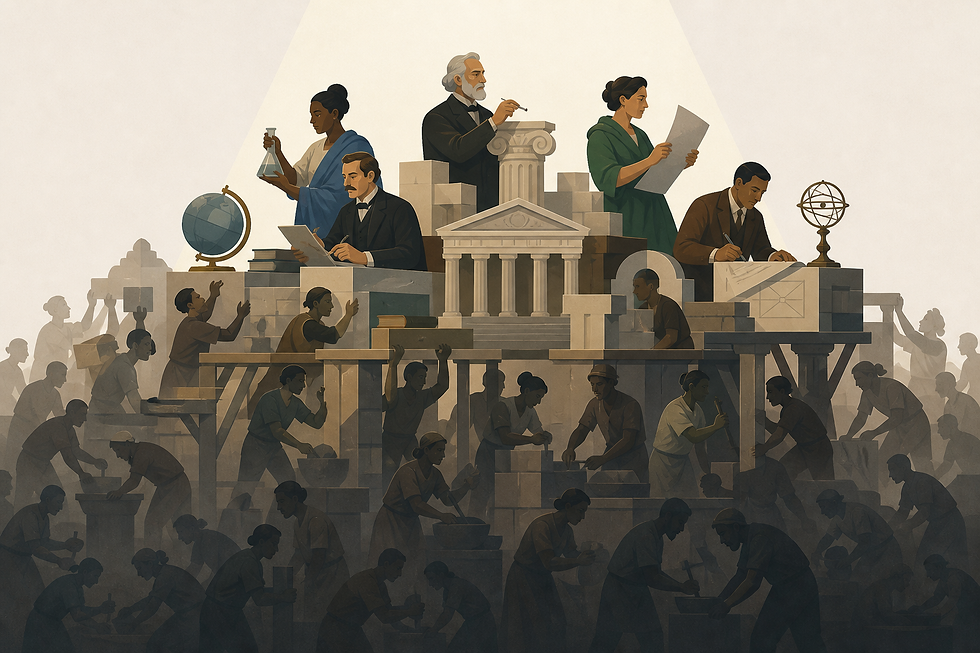
In 1744, a French philosopher spent her nights translating Isaac Newton's Principia Mathematica and correcting his math. Her name was Émilie du Châtelet, and for two centuries her work was credited to her lover, Voltaire. She isn't an outlier. She's a pattern.
History, as most of us learned it, runs on a short list of names, a handful of men whose achievements stand in for entire eras. But the actual record is wider and stranger than the textbook version. Women who reshaped intellectual life, a centuries-long civilization written out of "European" history, a plague that accidentally built the middle class, and ideas borrowed from societies Europe was busy conquering: these aren't footnotes. They're the parts of the story that explain how the rest of it happened.
Why the Omissions Matter
Leaving these stories out doesn't just shortchange the people involved. It distorts cause and effect. Understanding how erasure happened, who benefited from a simpler narrative, and why tells us as much as the achievements themselves.
It corrects the record, not just balances it. History wasn't shaped by a handful of men; it was shaped by whoever had access to power, credit, and preservation, and that access was never equal.
It restores causal links mainstream history flattens. The Renaissance didn't spring from nowhere; it grew out of centuries of translated Arabic scholarship. The middle class didn't emerge by accident; it followed a demographic catastrophe.
It has stakes today. The same dynamics that erased contributors then—who gets credited, whose knowledge counts as "real"—are still deciding whose work gets recognised now.
The Renaissance Women Written Out of Their Own Era
Michelangelo, Leonardo, Machiavelli: the Renaissance's usual cast is entirely male, despite women having shaped its art, politics, and ideas from the inside.
Sofonisba Anguissola (1532–1625) painted portraits with a psychological intimacy her male peers rarely attempted. Her work earned her a position at the Spanish court, an almost unheard-of honour for a woman artist. She wasn't a curiosity of her era; she was one of its most technically accomplished painters. Her absence from the standard canon reveals more about who controlled reputation-making than about her talent.
Isabella d'Este (1474–1539) ran her court in Mantua as a deliberate cultural engine, commissioning work from the era's best artists and setting taste for the rest of Italy. Rulers negotiated with her; artists competed for her patronage. She wielded the kind of soft power historians usually reserve for kings.
Margaret Cavendish (1623–1673) wrote on natural philosophy at a time when women were formally barred from the scientific societies debating those ideas. She published anyway, developing early theories of matter that anticipated later scientific thought. She was mocked in her lifetime as "Mad Madge." The mockery outlived the memory of what she actually argued.
None of this was accidental. Academies, patronage networks, and printing houses were controlled by men, and credit flowed to whoever controlled the record.
800 Years Europe Would Rather Forget
For nearly eight centuries, Muslim rule in the Iberian Peninsula produced one of the most significant intellectual exchanges in Western history, and most European history courses compress it into a paragraph.
Architecture and engineering: The Alhambra in Granada remains one of the most sophisticated examples of geometric design and water engineering from the medieval world, still studied by architects for its precision.
Science transmitted, not just produced: Scholars in Muslim Spain didn't only advance algebra, astronomy, and surgical medicine. They preserved and translated Greek philosophy that had been lost to Latin Europe, including much of Aristotle. When that material reached Christian scholars, it helped ignite the intellectual conditions for the Renaissance itself.
Philosophy: The 12th-century philosopher Averroes wrote commentaries on Aristotle so influential that Christian scholastic philosophy, including the work of Thomas Aquinas, developed partly in direct response to his ideas.
Without this transmission chain, the Renaissance doesn't happen the way it did, or possibly at all. Calling this period a footnote isn't just incomplete. It removes a load-bearing wall from the story of how Europe got its ideas back.
The Plague That Built the Middle Class
The Black Death killed up to 60 percent of some European populations in the 14th century. The death toll is the part everyone remembers. The aftermath is the part that mattered longest.
With a third to half of the workforce gone, surviving laborers suddenly had leverage they'd never had before. Peasants could demand wages, or simply leave for better terms elsewhere. Landowners who'd relied on captive labor now had to compete for workers. That leverage cracked the feudal system open, and a new class of independent laborers and tradespeople began to emerge in the gap.
Labor scarcity also accelerated technology. Within a century, the printing press arrived—because scarce labor makes automation worth the investment. The trauma of mass death reshaped culture directly: the danse macabre and memento mori traditions in art weren't decoration. They were a civilization processing loss in real time, and that preoccupation with mortality fed directly into Renaissance art's obsession with the human condition.
A demographic catastrophe restructured Europe's economy, its class system, and its art. This proof that some of the most consequential shifts in Western history were never planned by anyone.
The Societies Europe Learned From Before It Conquered
Indigenous societies shaped the civilization that displaced them, a fact conveniently absent from most accounts of Western development.
What fed a continent: Corn, potatoes, and tomatoes were all domesticated by Indigenous peoples in the Americas centuries before European contact. The potato in particular is credited with fueling population growth across 18th-century Europe by providing more calories per acre than any crop previously available there. A single crop transfer reshaped European demographics.
What shaped democratic thought: The Iroquois Confederacy operated on consensus-based governance among constituent nations centuries before European Enlightenment thinkers began writing about representative government. Benjamin Franklin studied Haudenosaunee governance directly while helping design the American political system—a documented influence, not a coincidence.
What we're only now taking seriously: Traditional ecological knowledge, including controlled burning, polyculture farming, and watershed management, is increasingly cited by modern environmental scientists as more sophisticated than the extractive approaches that replaced it after colonisation.
Ideas and resources moved from Indigenous societies into Western civilization, then the societies that produced them were erased from the credit.
The Enlightenment Thinkers Overshadowed by Voltaire and Locke
The Enlightenment gets remembered through a short, familiar list. The thinkers who don't make that list did work just as foundational.
Mary Wollstonecraft (1759–1797) didn't just write an early feminist tract. A Vindication of the Rights of Woman argued that denying women reason and education was a logical contradiction within Enlightenment philosophy itself. She beat Enlightenment thinkers at their own game, using their premises to expose their blind spot.
Cesare Beccaria (1738–1794) reframed the entire purpose of punishment, arguing against retribution and torture and for proportionality and rehabilitation. His writing directly shaped the American and French revolutions' legal thinking. Modern criminal justice reform debates are still, in essence, having his argument.
Émilie du Châtelet (1706–1749), the translator from our opening, didn't just render Newton into French. She argued for the conservation of energy years before it became accepted physics, doing original theoretical work that her own translator's introduction downplayed in favor of crediting the men around her.
Each of these thinkers did work as consequential as the "canon" names. Each was minimised by the same mechanism: control over who gets to be remembered as original.
The Pattern Is Still Running
This isn't just about the past. The same dynamic plays out now.
Immigrants and their children have founded a disproportionate share of America's most valuable startups. Immigrant-founded companies collectively employ millions of people domestically. Scientists born outside the U.S. account for a significant share of American Nobel laureates in the sciences. These aren't sentimental talking points. They're the same story of outsized contribution and under recognised credit, playing out in real time rather than in an archive.
The question worth sitting with isn't just "what did we forget." It's "who benefits when we do."
What forgotten history changed how you see the present?


Comments